00 · Context and Background
Principal PM at InfoBeans, embedded with SAG-AFTRA's product team
On this project I was Principal PM at InfoBeans, embedded directly with SAG-AFTRA's team.
I owned end-to-end product delivery: discovery, requirements definition, backlog prioritization, and agile execution through sprint planning, backlog grooming, and daily standups. Every design decision had to work for real members going through a high-stakes process and still hold up against compliance requirements.
My scope
Full lifecycle ownership, discovery through validated prototype. I led requirements definition, wrote user stories, prioritized the backlog, managed design execution, and drove agile delivery across a cross-functional team spanning design, engineering, and compliance.
The goal was simple: reduce the number of calls members had to make because they could not figure enrollment out on their own.
The organizational context
SAG-AFTRA represents 160,000+ performers across film, television, and broadcast. The health plan enrollment process touched every member at a high-stakes moment: transitions in coverage, changes in eligibility, payment deadlines.
Getting it wrong didn't just create confusion. It created gaps in coverage. That's what made every UX decision matter.
01 · Problem and Competitive Landscape
A process built around administration, and hard for members to navigate
Before defining any product requirements, I conducted a competitive analysis of health plan enrollment experiences across union and employer-sponsored platforms. The pattern was consistent: most enrollment products were built around administrative workflows. Clarity and confidence-building were afterthoughts, and SAG-AFTRA's platform reflected that.
I presented the competitive findings to SAG-AFTRA's product and compliance leadership alongside a current-state assessment of the enrollment experience, mapping where members were dropping off, where call volume was highest, and which eligibility scenarios were generating the most operational cost. That analysis shaped the product requirements and informed the recommendation to prioritize three specific flows for the MVP.
Members abandoned mid-flow with no feedback on what went wrong
The multi-step enrollment process gave members no clear indication when something failed or what to do next. Drop-off was high and the cause was invisible without call log analysis.
Plan transitions and coverage eligibility were too complex to self-navigate
Members with diverse eligibility scenarios, coverage transitions, and dependent changes couldn't figure out their options without calling support. Every edge case became a ticket.
Manual payment follow-up was consuming operational resources
No automated reminders existed for payment deadlines. Staff were spending disproportionate time on outreach that should have been handled by the product itself.
02 · Discovery, Strategy, and Agile Delivery
Discovery through delivery, with compliance in the room from day one
I led product discovery by aligning design, engineering, and compliance around shared business goals before any requirements were written. I conducted stakeholder interviews, workflow analysis, and a technical feasibility assessment to define the core user problems and validate which solutions were buildable within regulatory constraints. Research findings were synthesized into a prioritized requirements document and presented to SAG-AFTRA leadership before sprint planning began.
What I did
- Led cross-functional discovery sessions with design, engineering, and compliance to align on shared business goals before any requirements were written
- Conducted stakeholder interviews and call log analysis to identify where members were dropping off and what was driving support volume
- Ran a technical feasibility assessment to identify which solutions were viable within regulatory and system constraints
- Defined product requirements and user stories, presented prioritization recommendations to SAG-AFTRA leadership with KPI alignment for each
Key findings presented to leadership
- Drop-off was concentrated at two points: the eligibility determination step and the payment confirmation screen
- Members with coverage transitions had no self-service path, making every transition scenario a call
- Manual payment outreach was a direct consequence of no deadline visibility in the product
- Legal constraints ruled out direct member usability testing. CX team was identified as the viable surrogate research channel

Use cases and requirements framework, mapping member scenarios to enrollment flows
What I prioritized and why
- Step-by-step coverage guidance: highest-impact feature for task completion based on call log analysis and drop-off data
- Real-time payment visibility: addressed abandonment at the payment step, the second-highest drop-off point identified in discovery
- Automated deadline reminders: removes the manual follow-up burden entirely, direct reduction in operational cost
How I structured delivery
- Prioritized using MoSCoW framework, balancing member impact, regulatory constraints, and technical feasibility
- Structured roadmap in agile sprints with defined delivery milestones and go/no-go criteria at each phase
- Each feature mapped to a specific KPI: call deflection rate, enrollment completion rate, or operational cost reduction
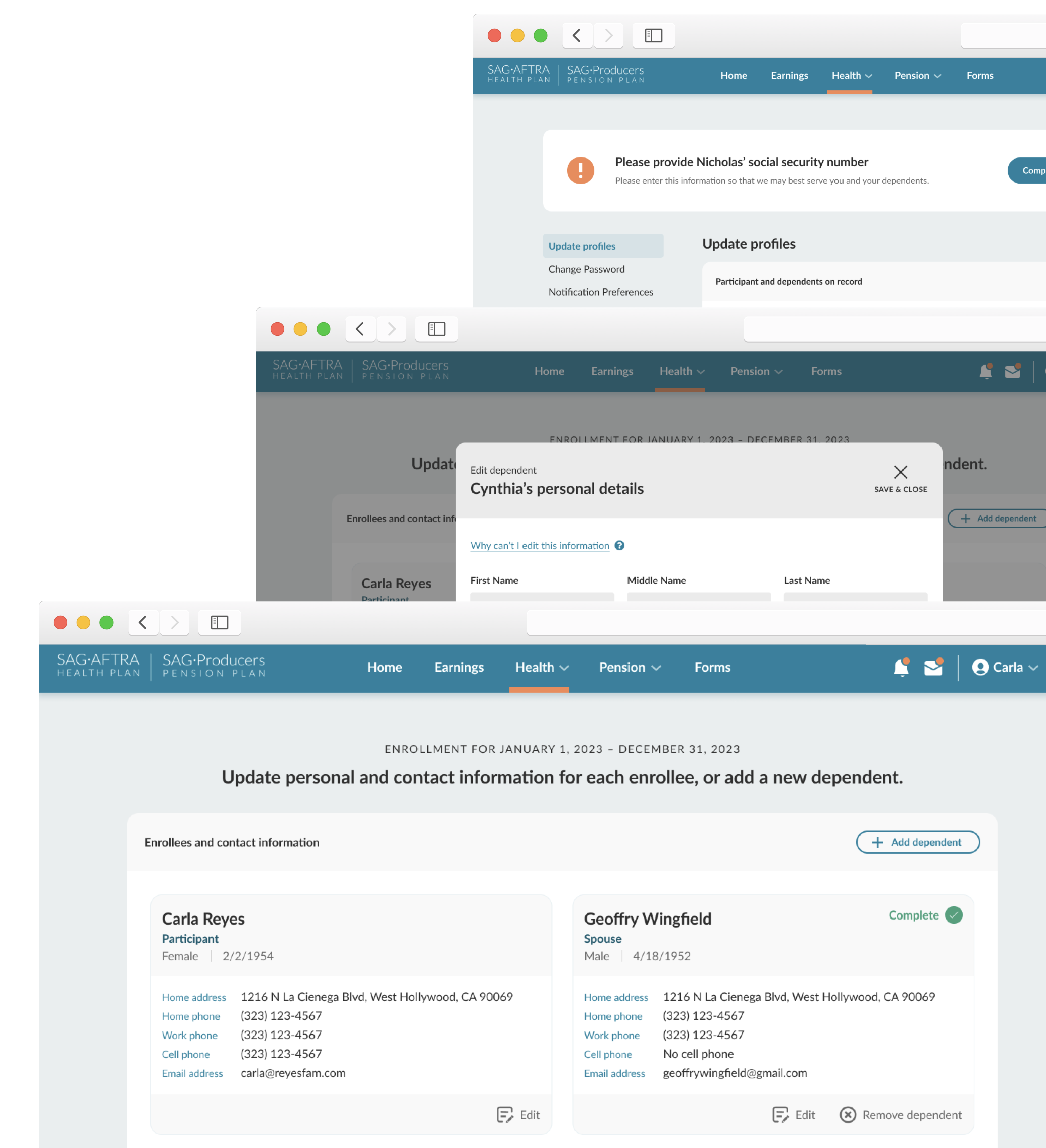
MVP prototype showing enrollment flow with step-by-step guidance and real-time payment visibility
What I did
- Drove agile execution through sprint planning, backlog grooming, and daily standups across design and engineering
- Acted as single point of accountability for product delivery, resolving blockers and keeping all three teams aligned on priorities
- Coordinated usability evaluation with SAG-AFTRA's CX team as surrogate members, structured as a formal research protocol with documented findings
- Synthesized CX team feedback into a prioritized revision list and presented recommendations to leadership before any design changes were made
Validation outcomes
- Simplified language and visual hierarchy throughout the enrollment flow, validated against real member scenarios by the CX team
- Coverage transition paths that previously required a support call were resolved within the product for the most common eligibility scenarios
- Content hierarchy and tone optimized for diverse member demographics across the union's 160,000+ membership
- Comprehensive design documentation produced for engineering handoff, enabling dev team to start without ambiguity
03 · Outcomes and Business Impact
A validated prototype that cleared the path for engineering
SAG-AFTRA's product, compliance, and engineering teams all signed off on the redesign. The modular structure and detailed documentation gave the engineering team a clear build path. No discovery sessions required after handoff.. Each deliverable connected back to the KPIs we defined at the start.
"We have clarity on a complex topic now. Having a well-thought-out and designed prototype makes building this way simpler. Chris's dedication to excellence, keen attention to detail, and collaborative approach were instrumental in our project's success."
Swati Chakraborty, Director of Product Management, SAG-AFTRA
↓
Member confusion and support call volume
Streamlined enrollment flows and clearer guidance positioned to significantly reduce inbound call volume, the primary operational KPI for this engagement.
✓
Engineering handoff completed without ambiguity
Comprehensive design documentation enabled the dev team to begin building immediately. No discovery sessions required post-handoff.
Strong
Stakeholder buy-in across all teams
Strong internal support driven by clarity and polish of the prototypes, and by the research-grounded rationale behind every design decision.
3
Next-phase priorities defined
Simplified language, enhanced visual cues, and AI-driven personalized guidance identified and scoped as next phase investment areas with KPI alignment.
04 · Reflection
What this engagement taught me about working in constrained conditions
SAG-AFTRA was one of the more constrained product engagements I've worked on. The regulatory environment limited what we could test and with whom. Working within those limits while still producing a validated, research-grounded product required more creative research design than a standard usability program.
What went well
Compliance in the room from day one
Getting design, engineering, and compliance aligned on shared goals at the start meant scope disputes didn't surface mid-sprint. Every requirement was written with regulatory feasibility already factored in.
CX team as surrogate users worked well
Despite legal limitations on direct member testing, the CX team's domain knowledge produced high-quality feedback that improved the flows in ways that surveys wouldn't have caught.
Modular design gave stakeholders confidence
Structuring the MVP as a modular system rather than a full redesign made the implementation feel tractable. Leadership could see a clear, phased path to build rather than a single large commitment.
What I'd do differently
Design a limited anonymized member testing protocol
The legal constraints on direct member testing were real, but a carefully scoped, anonymized protocol was likely possible. The CX proxy was good. Actual member signal on the highest-risk flows would have been better.
Map edge-case eligibility scenarios in week one
The range of eligibility configurations surfaced late. A comprehensive scenario mapping exercise at the start would have shaped the information architecture earlier and reduced mid-sprint revision cycles.
Scope the AI personalization roadmap in phase one
AI-driven guidance was identified as a future priority at the end of the engagement. Scoping it in phase one would have influenced architectural decisions made during the MVP build.
